

The transportation and logistics industry is advancing rapidly and has completely rewritten the standards for on-road delivery. Recently, more companies have begun directing their focus to the vehicles they use for deliveries and how they can improve their efficiency.
Electric vehicles, or EVs, have overhauled the automobile manufacturing process and are a clean and effective solution that’s revolutionizing the logistics industry. As EVs have become more accessible, they’ve also had a considerable impact on supply chain distributions. This post will discuss EVs’ impacts on the logistics industry and the advantages of electric vehicles for deliveries.
How Does the Logistics Industry Use EVs?
Many logistics companies have continually relied on vehicles with internal combustion engines (ICEs) as the primary choice for their delivery vans and trucks. However, these vehicles release additional carbon dioxide into the atmosphere, considerably reduce air quality and are far more expensive to maintain.
Businesses have begun to embrace electric vehicles for delivery. EVs have proven to be worthwhile investments as the logistics industry and electric mobility have become increasingly related. Government subsidies and other economic factors have also made sustainable vehicles more appealing.
EVs are suitable for many types of deliveries. They are incredibly effective for last-mile delivery due to their high maneuverability and small carbon footprint. They also promote pollution-free circulation, cut back considerably on carbon emissions, and are valuable for compact city centers, urban spaces and indoor spaces.
EVs also have the opportunity to create significant additional value for companies by promoting ongoing savings in operation and maintenance, improving delivery services’ routing efficiencies and providing the opportunity to build upon the services’ brand. As many supply chain companies strive for more effective, efficient and dependable delivery services, they’ve discovered the benefits of EVs as an innovative and sustainable long-term investment.
Industry-Specific Logistics Applications of EVs
Various sectors can benefit from transitioning to electric vehicles, including:

- Health care: EVs can offer reliable, temperature-controlled transport for pharmaceuticals, medical equipment or lab samples. Real-time tracking also ensures compliance with relevant industry regulations and helps combat contamination risks.
- Lab and chemical: Similarly to health care, businesses working with hazardous samples and lab specimens need fast, efficient transport. EVs can help ensure timely logistics and close monitoring to support the safety and quality of lab materials.
- Food and beverage: A huge advantage of EVs for the food and beverage industry is leveraging route optimization to help deliver perishable goods quickly. Advanced tracking and routing help reduce food waste and support more environmentally sound supply chains.
- Defense: Military operations can benefit from low-emission EVs for transporting personnel and sensitive equipment. EVs are quiet and cost-effective, and they can reduce emissions associated with military logistics.
- Wholesalers and manufacturing: These industries utilize EVs for transporting raw materials, equipment and components from suppliers to manufacturing plants. They can also use EVs for internal material handling needs and outbound logistics of finished goods.
- Legal: Organizations can use electric vehicles for logistics to transport documents between destinations, such as law firms, clients and courthouses.
The Future of Electric Vehicles in the Supply Chain
More car companies transitioning from gasoline- and diesel-fueled vehicles to electric vehicles has had a substantial impact on the supply chain. How will EVs continue to change the game? Let’s take a look.
1. At the Front of the Pack
The transition toward EVs from ICEs is a considerable advancement that’s here to stay. With many parts of the world aiming for carbon neutrality in the future, EVs’ impact on supply chain deliveries will become increasingly green over time. In the era of electric transport, gasoline- and diesel-powered vehicles will eventually become irrelevant, and it’ll become even more vital to adapt to greener trends to maintain relevance.
The ultimate success of the automotive sector will depend on a flourishing regional supply chain. The commercial market has made substantial progress in recent years toward an electric future. Experts predict that EVs will reshape the automotive industry and cause an influx of positive relationships with suppliers. The purchase and use of EVs will also benefit local manufacturing, creating and allowing for the retention of more jobs.
2. Mandates on the Horizon
As EVs have grown in popularity, numerous countries have considered entering into the electric vehicle supply chain. Nations with key global markets, such as England and China, are adopting EVs as a more energy-efficient transportation and on-road delivery method. The electric vehicles’ share of the automobile market continues to expand as production facilities boom worldwide.
In the United States, the story is a bit more complicated because the federal government is rolling back several EV initiatives. Still, many automakers and some states continue to promote EVs as the optimal form of transportation that will prevent greater pollution in urban communities subjected to excessive carbon emissions. Long-term EV adoption is expected to continue, but at a slower pace due to recent policy changes.
3. Increased Opportunity for Circular Supply
EVs use an electric motor that requires a battery rather than an engine to run and are dependent on technologically advanced semiconductors, sensors and other electronic components. To produce batteries for EVs, manufacturers have to obtain and refine raw materials, such as lithium, nickel, cobalt, copper, aluminum, manganese and graphite. As of 2021, new composite materials have also begun allowing for the production of lighter vehicles, which then extends the range of batteries for EVs.
A self-sustaining supply chain would allow companies to recycle or reuse raw materials from waste rather than mine from a limited supply.
4. Smart Technology Integration
Smart technology integration is crucial to the future of EVs within the supply chain. The following solutions make EV fleet management more efficient and effective:
- Telematics systems
- Advanced sensors
- Predictive maintenance systems
- Artificial intelligence (AI) route optimization
- Smart charging solutions
- Mobile apps for drivers
- Energy management systems (EMS)
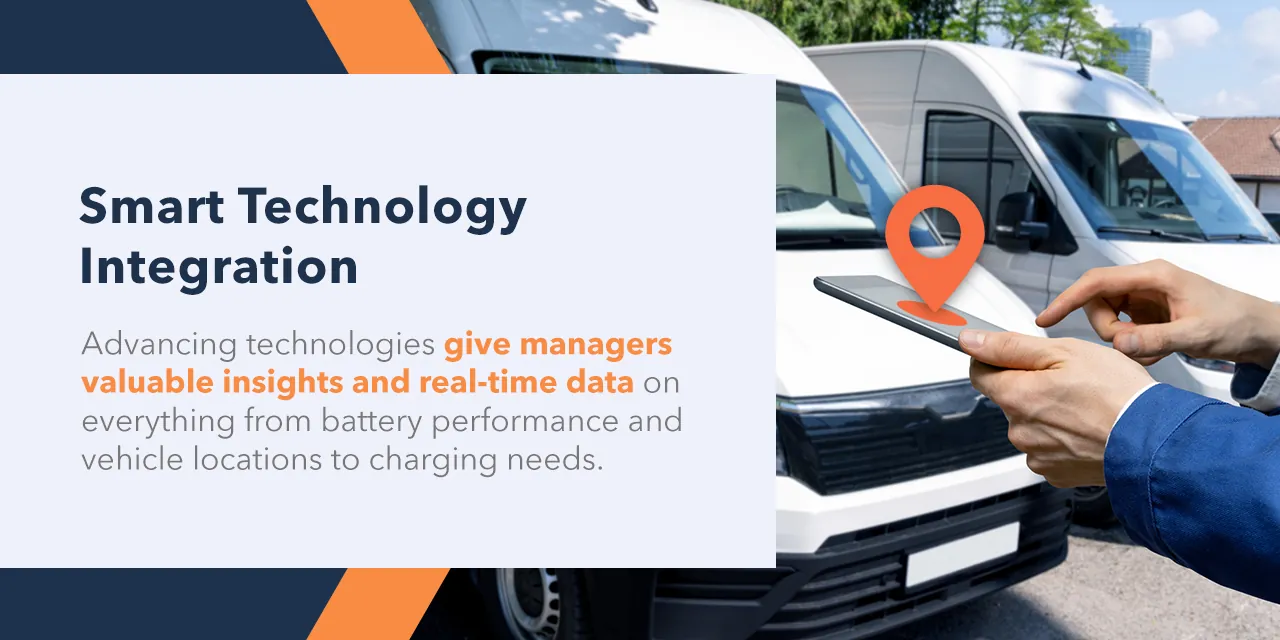
Advancing technologies give managers valuable insights and real-time data on everything from battery performance and vehicle locations to charging needs. These tools help optimize routes and enable proactive solutions to combat downtime and maintenance issues.
Smart technology integration is also improving EV charging systems in several ways. These tools can help businesses leverage power grid data for more effective energy management, minimizing charging costs and supporting a more stable power supply.
Businesses can use advanced technologies to establish greater operational efficiency, from dynamic routing to charging optimization, while contributing to a more resilient and less wasteful supply chain.
5. Government Incentives
Government incentives, such as tax credits, are also a driving force for the future of EVs in the supply chain. They are crucial to encouraging and accelerating the adoption of electric trucks and vans by businesses, making the switch from vehicles with ICEs to EVs more affordable.
Government incentives help businesses more easily transition to cleaner, more sustainable EV logistics operations by reducing the upfront expenses and financial risk associated with adoption. Examples of active incentives include:
- Commercial Clean Vehicle Tax Credit: This credit was introduced with the Inflation Reduction Act of 2022 to help businesses acquire cleaner vehicles.
- Alternative Fuel Vehicle Refueling Property Credit: This credit, also known as the EV Charging Infrastructure Tax Credit, is part of Section 30C of the Internal Revenue Code (IRC). It encourages the installation of EV charging equipment by offsetting related costs.
Both of these credits currently apply to qualified purchases and installations from January 1, 2023, through December 31, 2032. However, it’s important to monitor new legislation as the federal government proposes rollbacks on EV initiatives.
What Are the Overall Benefits of Electric Vehicles?
As electric vehicles become more mainstream, more businesses recognize their many advantages for transportation and parcel delivery.
Economic
Compared to ICEs, EVs boast significantly lower fuel costs. With lower per-mile energy expenses, EVs are far more cost-effective than traditional fuel-powered vehicles with gasoline or diesel fuel. Charging stations also provide a cost-effective way to refuel.
An EV’s mechanical systems are also much simpler and require minimal upkeep, so there’s no need for costly maintenance like oil changes. Plus, because EVs have single-speed transmissions and regenerative braking, they drastically reduce the level of wear and tear on the vehicle’s brake system. In terms of both power and economic value, EVs are incomparable.
Efficient
EVs are also incredibly efficient in terms of energy, torque and performance. EVs convert over 77% of the electrical energy from the grid to driving power, whereas conventional ICE vehicles only convert 12%-30% of the energy from gasoline.
Additionally, EVs use less energy in stop-and-go city traffic. Because they lack an exhaust system, they operate smoothly and quietly, reducing noise pollution alongside air pollution. EVs’ high-quality performance and convenience make them a highly compelling option for high-priority courier services.
Environmentally Friendly
EVs also have substantial environmental benefits due to their utilization of renewable energy. They produce zero tailpipe emissions, reduce the level of carbon dioxide in the atmosphere and lessen fossil fuel energy dependence. Every year, the carbon footprint of producing EVs continues to shrink as manufacturers prioritize electricity from nuclear-, hydro-, solar- or wind-powered plants, which cause no air pollutants.
According to the United States Environmental Protection Agency (EPA), the transportation sector produces 28% of the country’s greenhouse gas emissions, almost a quarter of which is due to trucks and vans. EVs are an excellent way to combat road pollution and help your business achieve a better bottom line.
ExpressIt’s EV Strategy
A growing number of logistics companies are adopting electric vehicles as a greener and more cost-effective e-commerce delivery method. ExpressIt has also made substantial efforts to ditch ICEs and take advantage of the many benefits of EVs to optimize our transportation network.
Aiming for the Future
ExpressIt Delivery has embraced the innovation of electric vehicles for delivery in the face of immense industry change and evolving customer expectations. By adding electric vans to our fleet, we’re consciously improving our contributions to a more sustainable future for transportation and courier services. We also aim to facilitate the transition to zero carbon emissions for a more sustainable and reliable delivery method. Additionally, we offer incentives to our drivers who already use electric vehicles as an internal motivation for adopting EVs.
Transforming With the Industry
ExpressIt’s wholehearted approach to the sustainable transportation of packages and freight is also central to our evolution. Our up-to-date logistics solutions and use of EVs are redefining how we satisfy the needs of numerous industries. Staying current with EVs’ impacts on the logistics industry also helps us maintain our position as a valuable delivery partner for your business.
Contact ExpressIt Delivery for Innovative Delivery Solutions
ExpressIt Delivery provides trusted delivery services across the Northeast and throughout the country. When you need same-day delivery services for high-priority items, ExpressIt will get the job done right. By embracing electric vehicles in the logistics industry and understanding their substantial impact on the automotive supply chain, we maintain an edge on faster, cleaner and more cost-effective services.
As a women-owned business in the logistics industry, we prioritize a family-oriented and compassionate approach to ensuring efficient and reliable delivery solutions for every business. Our experienced delivery professionals and specialists offer customized logistics options to accommodate your unique needs, such as routed delivery, last-mile delivery and on-demand service.
Contact us to schedule a delivery or request an obligation-free quote today.